
Green software development means building applications that deliver the same business value using less energy, fewer resources, and lower cloud costs. It’s not about “being eco-friendly” for branding — it’s about efficient engineering that reduces waste, improves performance, and scales sustainably.
Key Takeaways
- Green software development is about efficiency, not compromise
- Application design impacts energy usage more than most teams realize
- Sustainable software lowers cost, improves performance, and scales better
- Measuring and optimizing software demand is critical in 2025
- Good engineering is inherently sustainable engineering
What Is Green Software Development?
Green software development focuses on designing, building, and running software in a way that minimizes energy consumption and carbon emissions across its entire lifecycle — from code to cloud.
In practical terms, it means:
- Writing efficient code
- Reducing unnecessary computation and data transfer
- Designing architectures that scale without waste
According to Zartis and IBM, software alone contributes significantly to ICT’s growing carbon footprint, making application-level efficiency just as important as infrastructure choices.
Why Does Green Software Matter?
Because inefficient software is expensive, both financially and environmentally!
Data centers consumed over 415 TWh of electricity in 2024, and emissions are projected to rise sharply without efficiency gains. Businesses are already feeling the impact through rising cloud bills, stricter ESG reporting, and sustainability regulations in regions like the EU and India.
Green software development helps businesses:
- Reduce operational costs
- Improve application performance
- Prepare for ESG and compliance requirements
- Build future-ready digital products
Is Green Software About Code or Infrastructure?
Both — but software decisions come first. Green IT focuses primarily on hardware efficiency, while green cloud initiatives concentrate on optimizing infrastructure. Green software, however, goes a step deeper by reducing demand itself.
When software is designed efficiently, it minimizes unnecessary compute, avoids over-provisioned cloud resources, and reduces the need for constant scaling and patching.
Multiple studies show that optimizing the application layer delivers the most significant long-term impact because it lowers baseline resource consumption across the entire system, making sustainability a result of good engineering rather than an added constraint.
What Are the Core Principles of Green Software Engineering?
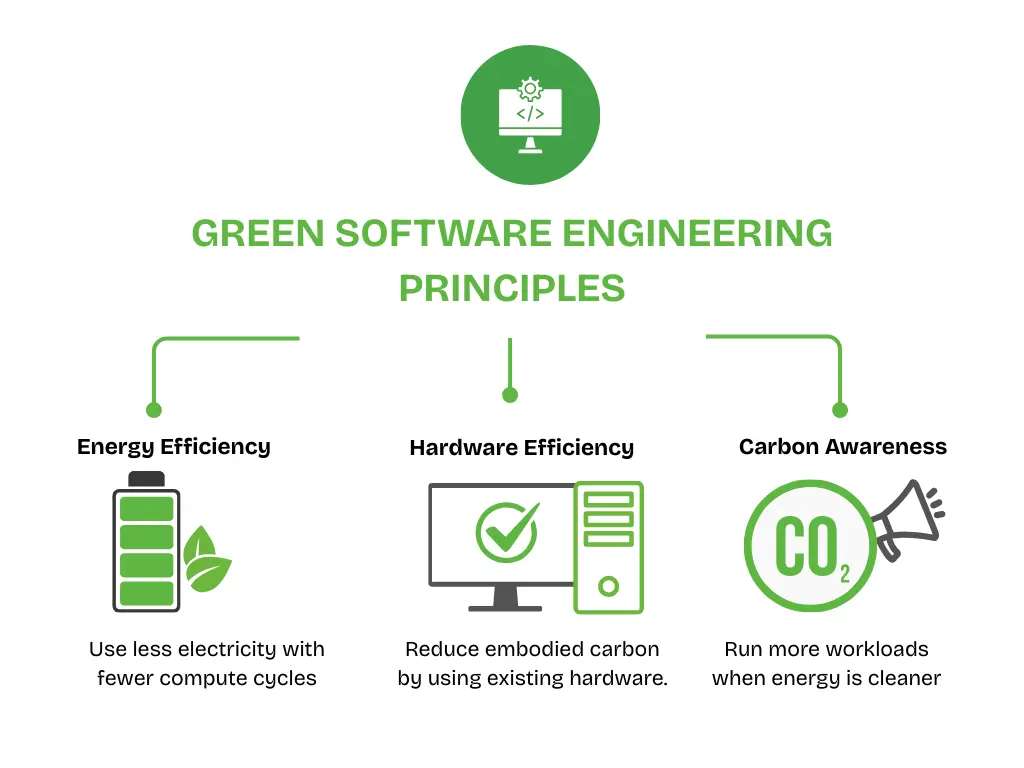
The Green Software Engineering Principles developed by the Green Software Foundation (GSF) and further refined for 2025, to reduce the overall carbon emissions from software applications. These concepts are divided into three main categories: energy efficiency, carbon awareness, and hardware efficiency.
1. Energy Efficiency (Consuming Less)
Energy efficiency focuses on reducing the total amount of electricity required for software to perform a given task. The goal is to achieve the same user outcome with fewer compute cycles and less processing overhead.
In practice, this means refining both code and architecture to eliminate unnecessary computation. Optimizing algorithms for better computational complexity, using efficient data structures, and avoiding redundant background processes significantly reduce energy consumption. Language and runtime choices also matter—high-performance languages and optimized frameworks can drastically lower compute usage for intensive workloads.
The key idea is simple – less computation equals less energy use.
2. Carbon Awareness (Consuming Better)
Carbon awareness focuses on timing and location, when and where that energy is consumed. Electricity grids vary in carbon intensity depending on time of day, location, and renewable energy availability.
Carbon efficiency: Deliver the same outcome with fewer emissions. achieved through carbon awareness (choosing the cleanest path) to ensure the least amount of actual carbon is emitted.
Climate Commitments: Align the design and operation of software systems with organizational and global sustainability goals (e.g., Net Zero, 1.5°C targets). These ensure the mechanisms used for carbon reduction are precise and align with the timing of renewable energy supply.
3. Hardware Efficiency (Using Resources Longer)
Focuses on the “Embodied Carbon”—the emissions caused by manufacturing and disposing of physical servers and devices.
Hardware/Resource Efficiency: Maximize the utilization of physical hardware to extend its lifespan and reduce the demand for new manufacturing.
What Green Coding Practices Actually Make a Difference?
Green coding practices turn efficient engineering into measurable business impact. Small technical decisions – such as algorithm efficiency, payload size, and background processing – compound at scale, resulting in reduced energy use, lower cloud costs, and lower long-term operational overhead.
Proven practices include:
Choosing energy-efficient languages for compute-heavy tasks
Optimizing algorithms (linear vs quadratic complexity)
Using lean data structures and caching intelligently
Reducing dependencies and payload sizes
Avoiding unnecessary background processing
Research shows that inefficient language or algorithm choices can consume 10x–70x more energy for the same task
How Do You Measure a Software System’s Carbon Footprint?
You can’t reduce a software system’s carbon footprint without first measuring it. In practice, software does not emit carbon directly — its footprint is estimated by translating resource consumption into energy use and then into emissions based on the carbon intensity of the electricity powering the infrastructure.
Measurement typically starts by defining a functional unit (such as emissions per transaction, request, or user action), followed by profiling CPU utilization, memory usage, storage, and network I/O across representative workloads. These measurements are compared against a baseline to quantify the impact of architectural or code-level optimizations.
Tools like Cloud Carbon Footprint help convert cloud usage data into carbon estimates by combining provider metrics with regional grid carbon intensity. Code-level profilers identify performance hotspots that often correlate with higher energy consumption, while carbon-aware scheduling can shift non-latency-sensitive workloads to times or regions with lower grid emissions.
These tools provide estimates and trends — not absolute truth — and must be applied with clear scope and engineering judgment to avoid false precision.
What Are the Business Benefits of Green Software?
Green software lowers costs, improves performance, and future-proofs your digital products. When applications are designed to use fewer resources, businesses see immediate benefits beyond sustainability.
Businesses adopting sustainable software practices consistently report:
- Lower cloud and infrastructure costs
- Faster, more resilient applications
- Easier scalability during traffic spikes
Stronger compliance and brand credibility
How Does Fegno Apply Green Software Principles in Practice?
At Fegno, sustainability is treated as a byproduct of good engineering—not a checkbox. As a software development company in Kochi, we focus on making architectural decisions early that reduce waste and support long-term scalability. Our approach to mobile and web app development emphasizes performance optimization, efficient APIs, and lightweight data transfer to minimize resource usage on both servers and user devices.
For enterprise systems, we prioritize ERP software implementation that eliminates redundant workflows, optimizes integrations, and scales cleanly as business operations grow. Combined with cloud right-sizing, continuous monitoring, and disciplined release practices, this approach helps clients reduce costs, improve reliability, and build software that grows responsibly over time.
Final Thought: Sustainable Software Is Simply Better Software
Green software development is not about sacrificing performance or speed—it’s about eliminating waste. By designing efficient architectures, writing optimized code, and measuring real resource usage, businesses can reduce cloud costs, improve reliability, and scale responsibly. The most sustainable systems are also the most resilient, maintainable, and future-ready.
As digital products grow more complex and infrastructure costs continue to rise, green software is no longer optional—it’s the new baseline for good engineering. Organizations that prioritize efficiency at the code, architecture, and system levels will outperform those that focus only on rapid delivery. In the long run, sustainable software isn’t just better for the environment—it’s better for business.

Senior Front-End Developer at Fegno Technologies with 5+ years of experience crafting clean, responsive, and scalable web applications. Specialized in React.js, Next.js, JavaScript, HTML5, and CSS3, turning complex ideas into seamless digital experiences. Passionate about UI/UX excellence, performance optimization, and modern web technologies.

 Schedule An Appointment