
Users today expect fast, seamless, and app-like experiences — without the friction of downloading an app. At the same time, businesses want cost-effective solutions that work across devices and platforms.
This is exactly where Progressive Web Apps (PWAs) come in. PWAs are powerful — but they are not a universal solution. Understanding their advantages and disadvantages is critical before making a decision.
What is a Progressive Web App (PWA)?
A Progressive Web App (PWA) is a web application built using modern web technologies that delivers an app-like experience directly through a web browser. Unlike traditional websites, PWAs can:
- Work offline
- Load instantly
- Be installed on a user’s device
- Send push notifications
In simple terms, PWA behaves like a mobile app — without being one.
How Progressive Web Apps Work?
A PWA functions through four core technical pillars— Service Worker, Web App Manifest, HTTPS Security, and Responsive Design. Here is the direct breakdown of how they work:
1. Service Workers
These are scripts that run in the background and enable:
- Offline functionality
- Caching for faster loading
- Background updates
2. Web App Manifest
This file allows users to install the app on their home screen with:
- App icon
- Splash screen
- Full-screen experience
3. HTTPS Security
PWAs must run on secure connections to ensure data safety. Because service workers can intercept network requests and modify responses, HTTPS is mandatory. This prevents “man-in-the-middle” attacks and ensures the integrity of the script execution.
4. Responsive Design
They adapt seamlessly across mobile, tablet, and desktop devices. PWAs utilize CSS Media Queries and flexible layouts to ensure the application remains functional across varying screen dimensions and input methods (touch vs. click).
Why Businesses Should Choose PWA Development?
Progressive Web Apps are increasingly adopted by businesses looking to balance performance, cost, and accessibility across platforms. We recommend PWAs to businesses aiming to bridge the gap between web reach and native app engagement without the high costs of maintaining separate codebases. Businesses seeking scalable, cost-effective digital solutions are increasingly adopting PWAs alongside services from a web development company in Kochi. Specifically, a PWA is the ideal solution for businesses that:
Prioritize Speed and Accessibility: If your users suffer from slow network conditions, PWAs use “service workers” to ensure the app loads instantly, even on 2G or 3G networks.
Want to Boost Conversion Rates: By eliminating the “App Store friction”—where users have to find, download, and wait for an installation—you allow customers to add your app to their home screen with a single tap.
Operate on Limited Budgets: Instead of developing three separate versions for Web, iOS, and Android, a PWA allows you to maintain one single codebase that works seamlessly across all platforms.
Depend on Re-engagement: For e-commerce or news platforms, the ability to send push notifications directly to a user’s device is a game-changer for driving repeat traffic.
Require Offline Functionality: If your service involves browsing catalogs, reading content, or filling out forms, a PWA ensures your brand remains functional even when the user loses their internet connection.
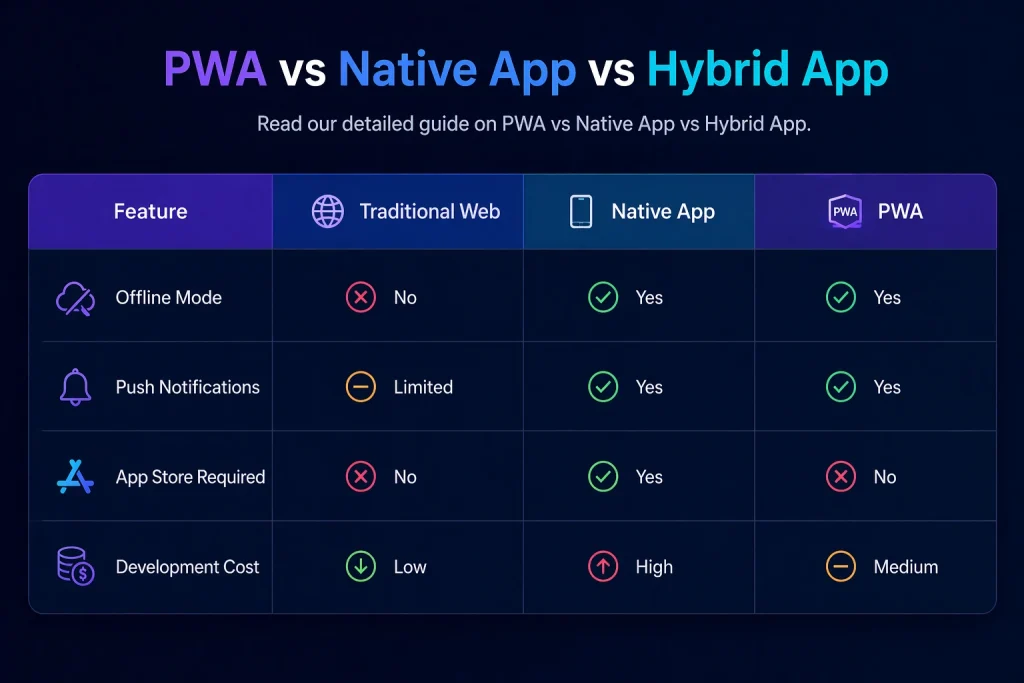
Read our detailed guide on PWA vs Native App vs Hybrid App
Choosing the right approach depends on your business goals, technical requirements, and long-term scalability. For businesses planning to implement a PWA effectively, working with an experienced app development service can help ensure the right architecture, performance, and user experience.
Advantages of Progressive Web Apps
1. Fast Performance
PWAs load instantly because they store the app’s skeleton locally on the device, resulting in faster interactions, lower bounce rates, and higher sales.
2. Cost-Effective Development
Instead of hiring separate teams to build and maintain an iOS app, an Android app, and a website, you build one PWA that works on all three. This makes PWAs an ideal solution for businesses working with a mobile app development service to reduce costs while maintaining performance. You maintain one codebase, one maintenance fee, and one software development life cycle.
3. No App Store Dependency
You don’t need Apple or Google’s permission to launch. Users install the app directly from your website. Result: No 30% store commissions, no long approval wait times, and instant updates for all users.
4. Offline Functionality
PWAs can work even with poor or no internet connection. Your customers can browse your catalogue while on a plane or in areas with poor signal. This is especially valuable in regions with unstable connectivity.
5. Push Notifications
PWAs allow you to send alerts directly to a user’s home screen, just like a native app, enabling effective re-engagement for sales, reminders, and updates. However, the effectiveness of push notifications depends on the platform and app architecture, which is why choosing between PWA, native, or hybrid apps becomes important.
Disadvantages of Progressive Web Apps
1. Limited iOS Capabilities
While Apple has improved support (including push notifications in modern versions), iOS still treats PWAs differently than Android. Apple restricts several PWA features, including:
- Apple now supports push notifications for PWAs (iOS 16.4+), but overall capabilities remain more limited than Android, especially in background processing and system-level access.
- Background processes
This alone can be a deal-breaker for some businesses.
2. Limited Access to Device Hardware
PWAs operate within the browser’s “sandbox” for security, which blocks them from talking to specific device hardware. PWAs cannot fully access:
- Bluetooth
- NFC
- Advanced camera features
Not suitable for fitness trackers, IoT controllers, or contactless payment apps, yet Native apps still win here.
3. Performance Limitations for Heavy Apps
PWAs run on JavaScript, which is fast but cannot match the raw power of “compiled” native code (Swift or Kotlin). High-intensity tasks like 3D Gaming, AR/VR, or Real-time Video Editing will lag or drain the battery faster in a PWA. If your app’s core value is high-end graphics or heavy processing, go native
4. Discoverability Challenges
Most users are conditioned to look for apps specifically in the App Store or Google Play Store. Because PWAs do not appear in these stores by default—unless they are “wrapped” and submitted manually—businesses often miss out on “store-shelf” discovery.
5. User Trust & Adoption
Some users still prefer downloading apps from official stores. For many, an app store listing acts as a badge of legitimacy, providing a sense of trust and security. Without this presence, PWAs may struggle to build the same level of immediate user confidence.
The Future of Progressive Web Apps
Progressive Web Apps are steadily evolving, but they are unlikely to replace native apps anytime soon. While Google continues to support and push PWA adoption, many businesses are embracing PWAs for their cost efficiency and cross-platform capabilities. However, limitations within Apple’s ecosystem still restrict its full potential. As a result, the future of application development is expected to be more balanced, with businesses adopting a hybrid approach rather than relying on a single solution.
Conclusion
Progressive Web Apps offer a powerful way to deliver fast, reliable, and cost-effective digital experiences. They are particularly effective for businesses looking to improve accessibility, reduce development costs, and reach a wider audience.
However, PWAs are not a one-size-fits-all solution. Their limitations in performance, hardware access, and platform support mean that native or hybrid apps may still be better suited for certain use cases.
The key is to choose the right approach based on your business goals, user expectations, and technical requirements.
If you’re planning to build a scalable and cost-effective web application, choosing the right PWA development service can help you implement the right architecture and achieve long-term success.

Head of Development at Fegno Technologies, with 12+ years of experience in product engineering. A specialist in technical architecture and UI/UX, he leads teams to build scalable, high-performance digital solutions.

 Schedule An Appointment