
Using the same anchor text on every backlink does not improve rankings — it usually does the opposite. Search engines look for variety in how websites link to you. A backlink profile built on repetition signals manipulation, not authority, and can quietly cap how well a page performs in search.
This guide breaks down the most common anchor text myths, what Google actually evaluates, and how to build a natural, sustainable link profile — whether you’re optimizing for traditional search rankings or for how AI tools like ChatGPT, Gemini, and Perplexity summarize and recommend your brand.
What Is Anchor Text?
Anchor text is the clickable text used in a hyperlink. It tells both users and search engines what the linked page is about.
Anchor text is one signal among many that search engines use to understand a page — not the deciding factor.
Types of Anchor Text
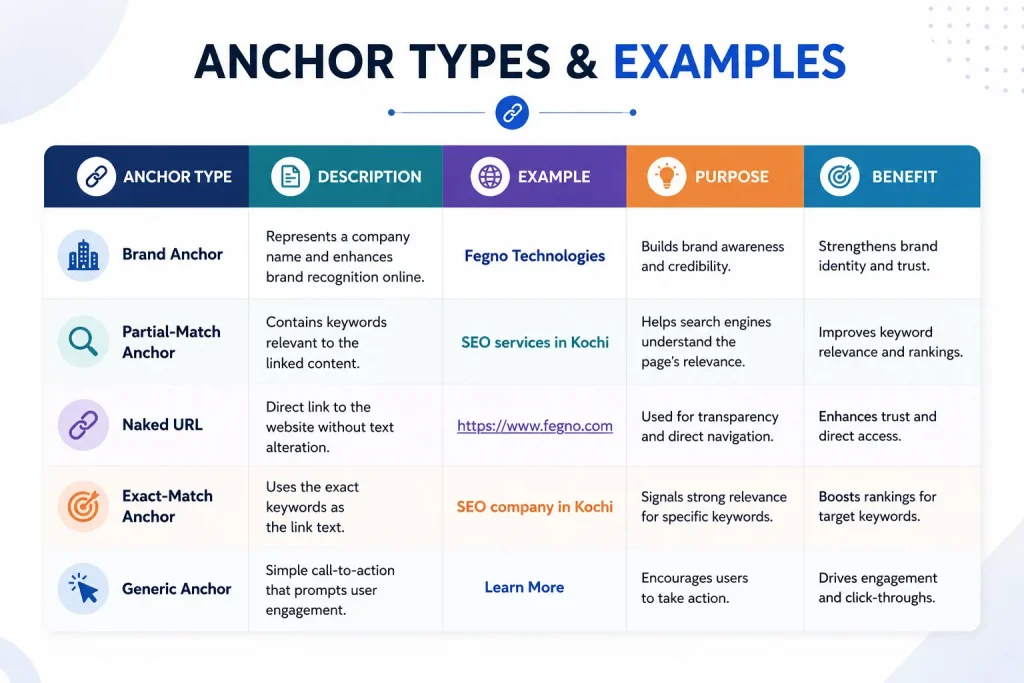
Understanding anchor text starts with recognising the different forms it can take. Each type sends a slightly different signal to search engines — and a healthy backlink profile contains a natural mix of all of them.
1. Branded Anchors
These use your company or product name as the link text. Examples: Fegno, Fegno Technologies. Branded anchors are among the most natural and safe anchor types because they reflect genuine brand recognition.
2. Naked URL Anchors
The URL itself is used as the visible link text — for example, https://www.fegno.com. Common in citations, press mentions, and forums.
3. Exact-Match Anchors
The anchor text matches the target keyword precisely — for example, SEO company in Kochi. Valuable when used sparingly; risky when overused.
4. Partial-Match Anchors
A variation of the target keyword is used — for example, SEO services in Kerala or digital marketing agency Kerala. These are a core component of a natural profile and carry strong relevance signals without the over-optimisation risk.
5. Generic Anchors
Non-descriptive phrases like click here, learn more, or visit website. These appear naturally in editorial content and help balance out keyword-heavy anchors.
6. Compound Anchors (Branded + Keyword)
A compound anchor combines your brand name with a topical keyword — for example, Fegno SEO services or Fegno digital transformation Kerala. These naturally appear when publishers reference your brand in context and send strong combined signals: brand recognition plus topical relevance. They are one of the most valuable anchor types for building entity authority.
7. Related / LSI Keyword Anchors
These use semantically associated phrases rather than an exact keyword. For a page targeting software development company Kerala, a related anchor might read tech solutions provider Kerala or custom app development India. Google’s language understanding means these still reinforce topical relevance without the manipulation risk of repeated exact-match anchors.
8. Image Alt Text Anchors
When another site links to yours using a clickable image — such as your company logo in a press mention, an infographic, or a product screenshot — the image’s alt attribute functions as the anchor text. This is why optimising alt text is both an accessibility practice and an SEO concern. For Fegno Technologies, if a tech media outlet embeds your logo linking to your homepage, the alt text (e.g. Fegno Technologies — software development company) becomes the effective anchor.
Why Does Anchor Text Matter for SEO?
Anchor text gives search engines contextual clues about the linked page’s topic. When multiple reputable sites naturally link to a page using related terms, Google gains more confidence that the page is genuinely relevant to that subject.
The operative word is naturally. Problems start when businesses try to force rankings by repeating the same keyword across dozens of backlinks instead of letting links happen organically.
Myth vs. Fact: What's Actually True About Anchor Text
Does using the same anchor text everywhere improve rankings?
No. This is one of the most persistent myths in SEO. A natural backlink profile contains a mix of anchor types — brand names, URLs, generic phrases, and keyword variations — because that’s how real websites actually link to each other.
When every single backlink uses the identical exact-match phrase, it looks manufactured rather than earned. Search engines are built to detect this pattern, and excessive repetition can reduce trust signals instead of building them.
Are exact-match anchors bad for SEO?
No — exact-match anchors aren’t inherently harmful. They add value when used sparingly and naturally. The issue isn’t that exact-match anchors exist; it’s overuse. A healthy backlink profile balances:
- Brand anchors
- Naked URLs
- Generic anchors
- Partial-match anchors
- Exact-match anchors
Is anchor text more important than the quality of the linking site?
No — link quality matters more than anchor text. A relevant backlink from a trusted, topically related website is typically far more valuable than a low-quality directory link that happens to use your exact target keyword.
Search engines weigh:
- Website authority
- Topical relevance
- Content quality
- Context around the link
- User value
Does Google only look at the words in the hyperlink?
No — Google evaluates the full context around a link. Beyond the anchor text itself, search engines also assess:
- The topic of the linking page
- The surrounding content
- Website authority
- Link placement
- Overall backlink patterns
A contextual link inside a genuinely relevant article almost always carries more weight than an isolated keyword anchor dropped on an unrelated page.
Does more backlinks always mean better rankings?
No — quality beats quantity. Ten high-quality backlinks from authoritative, relevant websites can outperform hundreds of low-quality links. Search engines prioritize trust and relevance over raw volume, so large-scale link campaigns chasing numbers alone often underdeliver.
What Does a Natural Anchor Text Profile Look Like?
A natural backlink profile mirrors how people genuinely talk about your brand online — not how you’d like to be ranked. For a business targeting “SEO Company in Kochi,” that means a mix like:
- Brand anchors: Fegno, Fegno Technologies
- Naked URLs: https://www.fegno.com
- Generic anchors: Learn More, Visit Website, Read More
- Partial-match anchors: SEO services in Kochi, technical SEO experts
- Exact-match anchors: SEO company in Kochi (used sparingly)
What ratio should you aim for? As a general benchmark, keyword-rich anchors — exact-match and partial-match combined — should ideally make up no more than 10–30% of your total backlink profile. The remaining 70–90% should be a natural blend of branded anchors, naked URLs, and generic phrases. The ideal ratio varies by niche and competitive landscape, so always analyse your top-ranking competitors’ anchor distribution before setting targets.
A poor anchor strategy looks like this:
SEO Company in Kochi → SEO Company in Kochi → SEO Company in Kochi → SEO Company in Kochi
A natural anchor strategy looks like this:
Fegno Technologies → SEO services in Kerala → Learn More → technical SEO specialists in Kochi → https://www.fegno.com → SEO company in Kochi (once)
How Does Google Identify Anchor Text Manipulation?
Search engines are increasingly effective at spotting unnatural link-building patterns. Common red flags include:
- Excessive exact-match anchors — the same keyword repeated across many links
- Irrelevant linking sources — backlinks from sites unrelated to your industry
- Sudden link spikes — large numbers of backlinks acquired in a short window
- Low-quality directories — links built purely for SEO with no user value
- Automated link building — tools or networks designed to inflate backlink counts artificially
This isn’t a new concern. Google’s Penguin algorithm update (2012) was specifically designed to penalise websites with manipulative backlink profiles — particularly those using repetitive exact-match anchor text at scale. Penguin became part of Google’s core algorithm in 2016, meaning these signals are now evaluated in real time, continuously, rather than in periodic updates. Understanding this history explains why anchor text manipulation carries lasting risk — not just a temporary ranking dip.
Any of these patterns can weaken trust signals and limit the long-term impact of your SEO efforts.
The Bigger SEO Lesson: Earn Links, Don't Engineer Them
Internal Links: The Anchor Text You Control Completely
Unlike backlinks — where you rely on external publishers to choose appropriate anchor text — internal links give you complete control. Every internal link on your own website is an opportunity to send a clear, deliberate relevance signal to search engines about the destination page.
Best practices for internal anchor text:
- Use descriptive partial-match or related-keyword anchors that naturally describe the page being linked to. For example, linking to your development services with the anchor custom software development Kerala is more informative than click here.
- Vary the anchor phrasing slightly across different articles — don’t link to the same page from multiple posts using the same anchor text every time.
- Avoid using your primary focus keyword as the anchor on every internal link — it can create competing signals across your own pages.
- Prioritise linking to your key service pages — SEO, software development, digital transformation — from relevant blog content using contextually appropriate anchors.
Internal linking is often underutilised, yet it’s the one dimension of anchor text optimisation that requires no outreach, no relationship-building, and no waiting. It can be improved today.
How to Check Your Current Anchor Text Distribution
Knowing your current anchor text distribution is the essential first step to improving it. Here is a straightforward process:
- Export your backlink profile from Google Search Console, Semrush, SE Ranking, or Ahrefs.
- Categorise each anchor into: branded, naked URL, exact-match, partial-match, related/LSI, or generic.
- Calculate the percentage share of each type across your total backlinks.
- Flag over-concentration — if exact-match or partial-match anchors exceed 30%, consider diversifying future outreach. An anchor like enterprise software solutions Kochi appearing on 40% of your links is a warning sign even if the anchor seems benign.
- Identify toxic anchors — anchors on irrelevant or low-authority sites that have no topical connection to your business may warrant a disavow request via Google Search Console.
Performing this audit quarterly keeps your backlink profile healthy and helps you catch suspicious anchor spikes before they affect rankings.
Anchor Text Signals and AI-Powered Search
Conclusion
Frequently Asked Questions
Is it bad to use exact-match anchor text?
No, exact-match anchors aren’t inherently bad — they’re a normal part of a healthy link profile. The risk only appears when they’re overused across most or all of your backlinks instead of being one variation among several.
How much anchor text variation do I need?
There’s no single perfect ratio, but keyword-rich anchors — exact-match and partial-match combined — should generally stay below 30% of your total backlink profile. The bulk of your anchors should be branded, naked URLs, or generic phrases that occur naturally as people reference your brand online.
Can bad anchor text hurt my rankings?
Yes. An anchor profile that’s overloaded with the same exact-match keyword can trigger search engines to treat your backlinks as manipulative, which may reduce the trust and ranking value those links would otherwise pass on.
What is a compound anchor text?
A compound anchor combines your brand name with a keyword — for example, Fegno SEO services or Fegno digital marketing Kerala. These are among the most natural and authoritative anchor types because they signal both brand identity and topical relevance simultaneously.
Does anchor text matter for AI search tools like ChatGPT or Perplexity?
Yes, increasingly so. AI language models learn associations from how web content references brands. A consistent pattern of natural, topically relevant anchor text across authoritative sources helps establish your brand as the credible entity for a given subject — which influences how AI tools surface and recommend you.

Sreekumar is an SEO Analyst at Fegno Technologies, with over 10 years of expertise in optimizing websites for search engines, enhancing their online visibility, and developing data-driven SEO strategies. Passionate about delivering measurable results and staying ahead of industry trends.

 Schedule An Appointment