
Have you ever wondered, ‘Why does my app’s cloud bill skyrocket?’ It’s often wasteful code quietly guzzling CPU and energy in the background. Software guzzles massive energy, and your app’s inefficiencies add up to larger cloud bills fast. So, what’s the fix? The answer is Green coding.
What Is Green Coding?
Green coding is the practice of writing software that delivers the same features and user experience while using fewer computational resources. It operates strictly at the implementation level, focusing on how code is written, executed, and optimized.
Green coding is often confused with green software development, but the scope is different. While green software development focuses on architecture, infrastructure, and system-wide sustainability, green coding concentrates on code-level efficiency and optimisation. Instead of aggressively consuming CPU, memory, and system resources, green coding achieves the same outcomes with fewer compute cycles and lower power usage—no compromises, just smarter engineering.
Green Coding vs Green Software Development
| Aspect | Green Coding | Green Software Development |
|---|---|---|
| Focus | Code-level optimizations like algorithms, loops, and execution efficiency. | The entire ecosystem including architecture, infrastructure, hardware, and deployment. |
| Scope | Implementation details—fewer CPU cycles, memory, power for same features. | System-wide sustainability across design, operations, and maintenance. |
| Key Practices | Efficient data structures, payload compression, re-render reduction. | Carbon-aware scaling, renewable hosting, demand shifting. |
| Goal | Same UX with less compute—no compromises, just smarter code. | Minimize total carbon footprint via holistic strategies. |
Why Green Coding Matters
The best way to describe “green coding” is as “energy-aware software design.” Just as a healthier lifestyle reduces long-term strain on the body, efficient code reduces operational strain on servers, cloud resources, and end-user devices.
According to the World Economic Forum, data centres already account for around 1% of global greenhouse gas emissions, and energy demand continues to rise rapidly due to cloud growth and AI workloads.
At a technical level, green coding focuses on minimizing unnecessary computation and resource waste through efficient algorithms, data structures, and runtime behavior. Unlike infrastructure-only optimizations, green coding starts at the source—the code itself. Even small inefficiencies, when executed millions of times at scale, can translate into significant energy usage and operational cost. By addressing these issues early, developers can achieve some of the highest-impact performance and efficiency gains with minimal architectural change.
This becomes increasingly important as modern software grows more complex, driven by richer interfaces, real-time processing, and continuous background operations.
Core Green Coding Principles
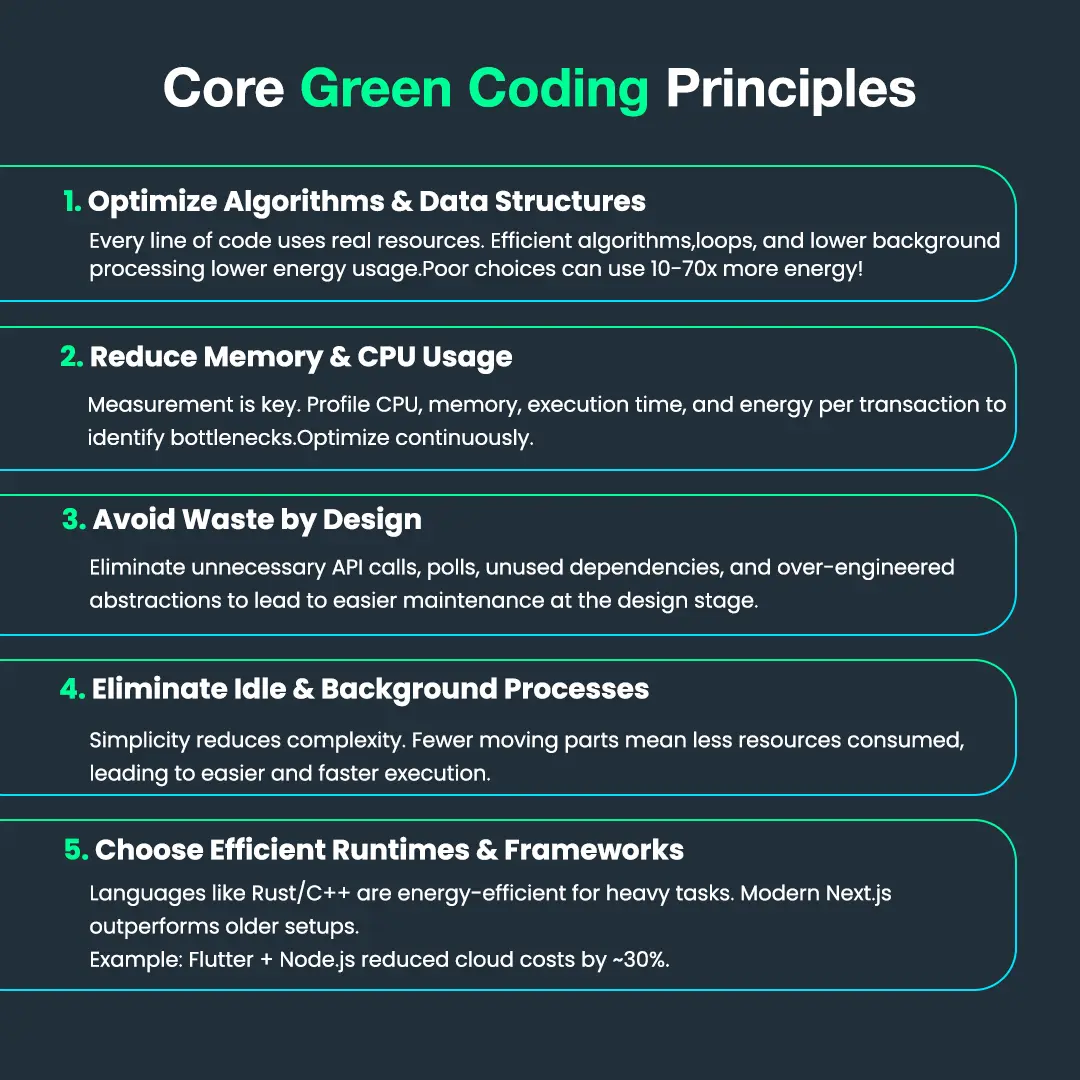
Green coding principles guide developers to build efficient, low-waste code that performs well without excessive resource consumption. The core idea is that ‘every line of code has a physical cost’. As a leading software development company that follows green practices, our developers adhere to green coding principles. Therefore, we focus on transitioning from “Does this work?” to “Does this work with the least amount of waste?”
1. Optimize Algorithms and Data Structures
Every line of code uses real resources like CPU cycles and electricity. Poor algorithm choices can consume 10 to 70 times more energy for the same task. Efficient algorithms, fewer loops, reduced background processing, and avoiding unnecessary recalculations can significantly lower energy usage.
2. Reduce Memory and CPU Usage
Energy-efficient coding starts with measurement. Profiling CPU usage, memory consumption, execution time, and energy per transaction helps identify real bottlenecks instead of relying on assumptions. This practice of continuous measurement and optimization is a key part of a mature and sustainable SDLC methodology, integrating performance goals directly into the development lifecycle.
3. Avoid Waste by Design
Unnecessary API calls, polling mechanisms, unused dependencies, and over-engineered abstractions all contribute to wasted energy. Green coding removes this waste at the design stage.
4. Eliminate Idle and Background Processes
Choosing simplicity over complexity leads to code that is easier to maintain, faster to execute, and cheaper to run. Fewer moving parts mean fewer resources consumed.
5. Choose Efficient Runtimes and Frameworks
Different languages and frameworks have different energy profiles. Lower-level languages like Rust or C++ are generally more energy-efficient than Python for compute-heavy workloads, while modern frameworks such as Next.js often outperform older setups like Create React App.
In practice, combining optimized Flutter for cross-platform apps with lightweight Node.js APIs has helped reduce cloud infrastructure costs by nearly 30% for several projects—without cutting features or performance.
Energy-Efficient Coding Practices
These aren’t fluffy eco-trends—they’re practical engineering habits that deliver the same results with 30–70% less energy. At Fegno, we apply these practices daily across Flutter, React, Python, and ERP projects such as Odoo implementations, where efficiency directly impacts performance, scalability, and operational cost.
1. Optimize Algorithms and Data Structures
Poor algorithmic choices can consume 10x–70x more energy for the same task. Selecting optimal time and space complexity has one of the biggest impacts on energy efficiency.
2. Reduce Memory and CPU Usage
Memory leaks, excessive object creation, and inefficient caching increase CPU cycles and power draw. Profiling and refactoring hot paths significantly reduce energy consumption.
3. Minimize Network and I/O Operations
Network calls and disk I/O are expensive. Batch requests, compress payloads, and avoid unnecessary database queries to reduce energy use across distributed systems.
4. Eliminate Idle and Background Processes
Background jobs that poll frequently or remain idle still consume resources. Replace polling with event-driven architectures or scheduled execution where possible.
5. Choose Efficient Runtimes and Frameworks
Choosing efficient tech stacks reduces resource consumption. “Lower-level languages like Rust or C++ are generally more energy-efficient than Python for compute-heavy workloads, just as modern frameworks like Next.js often outperform older setups like Create React App.
We apply this principle in practice by combining optimized Flutter for cross-platform app development with lightweight Node.js APIs—an approach that has helped multiple clients reduce their cloud infrastructure costs by nearly 30% without sacrificing features or performance.
How Green Coding Benefits Businesses?
Green coding is not just an engineering concern—it’s a clear business advantage. By reducing unnecessary compute usage, efficient code directly lowers cloud and infrastructure costs while improving scalability without the need for aggressive over-provisioning. Well-optimized systems perform more reliably during traffic spikes, require less maintenance over time, and accumulate significantly less technical debt. At the same time, energy-efficient software aligns better with modern sustainability and governance expectations, making systems easier to operate, scale, and manage in the long run.
Measuring the Impact of Green Coding
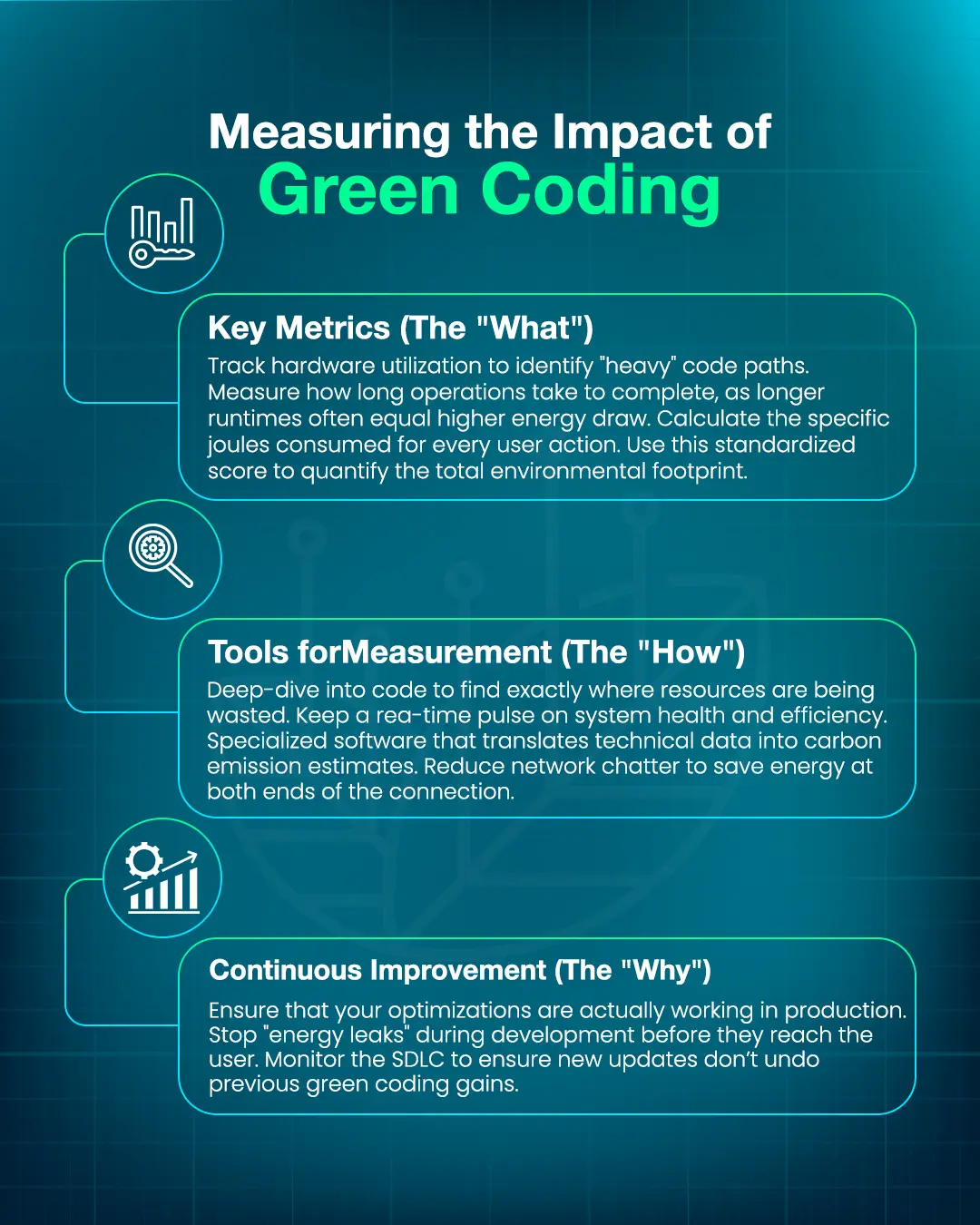
To make green coding effective, teams must measure its real impact rather than relying on assumptions. This includes tracking how much CPU and memory are used per request, how long operations take to execute, and how much energy is consumed for each transaction.
Metrics such as Software Carbon Intensity (SCI) help quantify the environmental footprint of software systems. Using profilers, performance monitoring tools, and carbon-tracking utilities allows teams to validate improvements, catch inefficiencies early, and ensure that energy efficiency does not degrade over time as the system evolves.
Getting Started With Green Coding Practices
You don’t need to rebuild your entire system to adopt green coding. Small, intentional improvements can make a meaningful difference over time—especially as your software scales.
Profile existing code to identify inefficient areas: Start by profiling your existing code to see where it consumes the most CPU, memory, or network resources. This helps identify real performance bottlenecks—such as slow functions or unnecessary background tasks—so you optimize what actually matters, not assumptions.
Refactor the most resource-intensive components first: Focus on optimizing the parts of the system that consume the most resources, such as heavy APIs, slow database queries, or expensive UI renders. Fixing these high-impact areas delivers far greater energy and performance gains than small changes across the codebase.
Measure before and after changes: Always compare resource usage and performance before and after optimizations. This confirms that changes actually reduce energy consumption and don’t introduce regressions or new issues.
Make energy efficiency part of code reviews: Treat efficiency as a quality standard alongside readability and security by questioning unnecessary loops, repeated API calls, and wasteful background logic during reviews.
Apply green coding principles to new features by default: Design new features with efficiency in mind from the beginning. Lean logic, minimal background processing, and efficient data handling prevent future refactoring and keep the system lightweight as it scales.
Incremental improvements may seem small, but at scale they compound quickly—resulting in lower costs, better performance, and more sustainable software over time.
Quick Start Guide to Green Coding
- Audit: Profile performance and energy hotspots using free profiling tools.
- Refactor: Optimize algorithms and data-heavy operations first for maximum impact.
- Measure: Track performance and energy usage before and after changes.
- Iterate: Make efficiency a standard part of code reviews.
Start small—optimizing even one module can create momentum across the codebase. Choose one practice today and build from there.
Conclusion: Green Coding Is Just Better Engineering
Green coding is not about environmental slogans—it is about disciplined coding practices. Efficient code runs faster, costs less, scales more predictably, and is easier to maintain. For developers, it enforces better habits. For businesses, it delivers performance and cost advantages without sacrificing features.
In the long run, writing better code isn’t just greener—it’s smarter.

Head of Development at Fegno Technologies, with 12+ years of experience in product engineering. A specialist in technical architecture and UI/UX, he leads teams to build scalable, high-performance digital solutions.

 Schedule An Appointment