
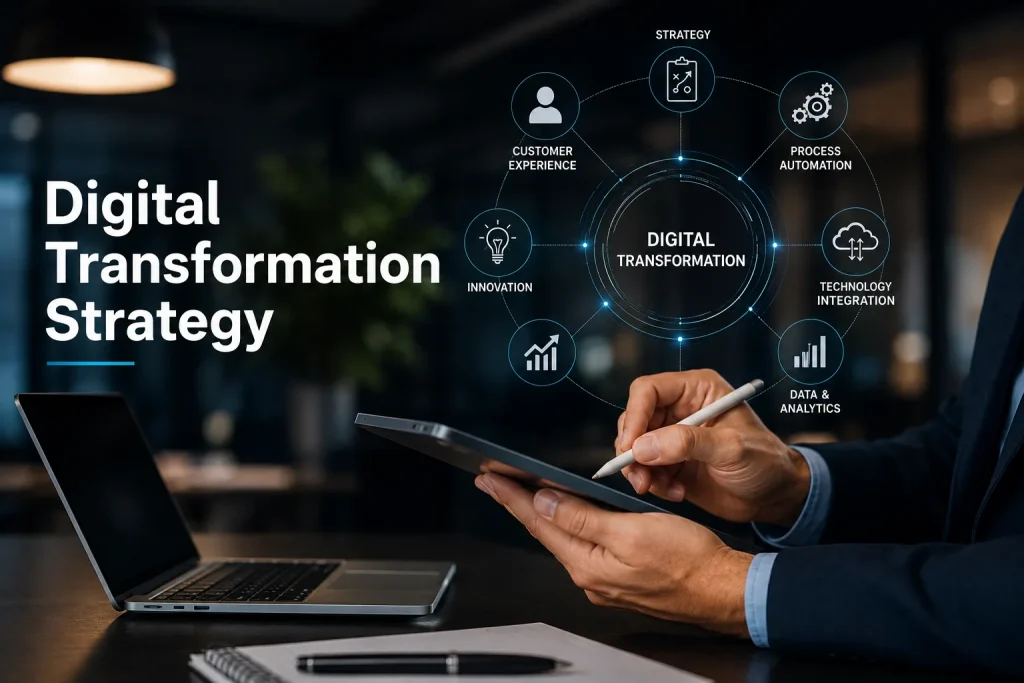
Digital transformation is not simply about adopting new software. It is about changing how a business operates, connects with customers, manages information, and scales by combining the right technology, processes, people, and data. A well-defined digital transformation strategy helps organizations move from disconnected systems and manual workflows to a more connected, efficient, and scalable digital operating model.
For businesses planning their next stage of growth, the challenge is rarely a lack of available technology. The harder question is knowing which problems to solve, which technologies to adopt, and how those technologies should work together. This guide explains what a digital transformation strategy involves, how to build a practical roadmap, the technologies that can support it, common mistakes to avoid, and how businesses can approach transformation with a clear focus on measurable outcomes.
What Is a Digital Transformation Strategy?
A digital transformation strategy is a structured plan for using technology to improve business operations, customer experiences, decision-making, and long-term growth. It connects business objectives with process improvements, digital systems, automation, data, and customer-facing experiences.
Rather than treating technology as a collection of separate projects, a transformation strategy looks at the business as a connected ecosystem. An organization may need an ERP to unify operations, custom software for a unique workflow, a modern website to improve customer acquisition, an ecommerce platform for digital sales, and SEO and digital marketing to make those digital channels discoverable.
The objective is not to add technology everywhere. The objective is to use the right technology where it can create measurable business value.
Digital Transformation vs. Digitization vs. Digitalization
What Is Digitization?
Digitization is the process of converting information from a physical or analog format into a digital one. Scanning paper records into digital files is a simple example.
What Is Digitalization?
Digitalization goes a step further by using digital technology to improve an existing process. Replacing a manual approval workflow with a digital workflow can reduce administrative effort and make the process easier to track.
What Is Digital Transformation?
Digital transformation is broader. It involves redesigning how an organization operates and creates value by combining technology, process improvement, data, automation, and digital experiences.
In simple terms: digitization converts information, digitalization improves processes, and digital transformation changes the way the business operates.
What Does a Digital Transformation Strategy Include?
1. Business Process Assessment
Transformation should begin with the business rather than a technology shortlist. Organizations need to understand where work is delayed, where teams rely on spreadsheets or manual processes, where systems do not communicate with each other, and where customers experience friction. A process assessment helps identify the areas where technology can create the greatest impact and prevents businesses from investing in software that solves the wrong problem.
2. ERP Implementation and Business Process Automation
For organizations managing complex operations, an ERP can provide the foundation for digital transformation. Odoo ERP implementation can connect areas such as CRM, sales, finance, inventory, procurement, manufacturing, HR, and reporting within a unified business platform.
ERP implementation should not simply digitize inefficient processes. The real value comes from understanding existing workflows, redesigning them where necessary, configuring the system around business requirements, integrating other applications, and helping teams adopt the new way of working.
3. Custom Software Development
Off-the-shelf platforms are not the right answer for every business challenge. Organizations with unique workflows, specialized industry requirements, legacy systems, or complex integration needs may require custom software.
Custom software can support internal business applications, customer portals, enterprise workflows, integrations, and digital products that need to scale with the organization, making software development a complementary capability alongside ERP and other existing systems.
4. Web Development and Digital Experiences
A company’s website is often the most visible part of its digital ecosystem. A modern web development solution should go beyond visual presentation and support usability, performance, accessibility, lead generation, integrations, and future scalability.
For businesses undergoing digital transformation, the website may need to connect with CRM, ERP, ecommerce, marketing, analytics, or other internal systems, making web development an important part of the wider technology architecture rather than an isolated design project.
5. UI/UX Design
Technology only creates value when people can use it effectively. UI/UX design helps businesses create intuitive interfaces and digital experiences that make websites, applications, portals, and business systems easier to understand and use.
Good UX can reduce friction in customer journeys and improve adoption among employees. In a transformation project, design should therefore be considered alongside functionality, not added as an afterthought.
6. Mobile App Development and Progressive Web Apps
Mobile applications can extend digital transformation beyond the desktop. Mobile app development can support customer applications, employee tools, ordering systems, field-service workflows, and business portals.
For some use cases, a Progressive Web App (PWA) can provide an app-like experience through the web while offering a practical alternative to building separate native applications for every platform.
7. Ecommerce Development and Digital Commerce
For businesses selling products or services online, ecommerce development can become a central component of digital transformation. A modern ecommerce platform can connect product information, customer accounts, orders, payments, inventory, logistics, and marketing.
The greatest opportunity comes when ecommerce is connected to the wider business ecosystem. Integrating ecommerce with ERP, CRM, inventory, and marketing systems can reduce manual data entry, improve order visibility, and create a more consistent customer experience.
8. SEO and Digital Marketing
Building a digital product is only part of transformation. Businesses also need to make their digital presence discoverable and capable of generating demand. SEO can strengthen organic visibility through technical optimization, content, local search, structured data, and search-focused strategies.
A broader digital marketing strategy can combine search, content, social media, paid campaigns, and other digital channels to attract and engage relevant audiences. Digital marketing should therefore be viewed as part of the transformation ecosystem: technology creates the digital experience, while marketing helps the right audience find and engage with it.
9. Creative Design and Brand Experience
Digital transformation also affects how a business presents itself across digital touchpoints. Creative design can support consistent visual communication across websites, campaigns, product experiences, social channels, and other customer-facing platforms.
A consistent digital identity helps businesses communicate their value clearly while creating a more recognizable experience across channels.
A Practical Digital Transformation Framework
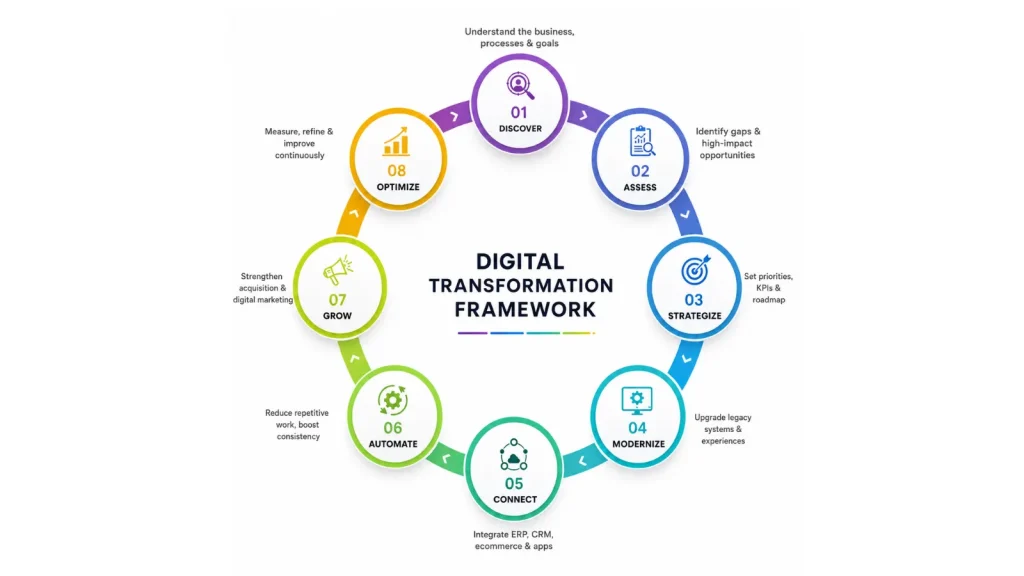
Rather than opening with a shopping list of technologies, a workable transformation framework starts with the business itself and builds outward in eight connected stages.
It begins with Discover, where the priority is simply understanding how the business actually works today — its operating model, its customers, its technology environment, and where it wants to grow. From there, Assess takes a harder look at the details: the inefficiencies, technology gaps, disconnected systems, and manual workflows that are quietly costing time and money.
Once the picture is clear, Strategize turns those findings into direction — setting priorities, defining KPIs, and mapping out an implementation roadmap. Modernize follows, upgrading legacy applications, websites, and processes wherever the upgrade will create measurable value, rather than modernizing for its own sake.
The next two stages are where transformation starts to compound. Connect integrates ERP, CRM, ecommerce, websites, applications, and APIs so information stops living in silos, and Automate applies workflow automation and intelligent technologies to cut repetitive work and improve consistency across the organization.
Finally, Grow turns the newly connected, automated foundation into a growth engine — strengthening customer acquisition, digital experiences, ecommerce, SEO, and marketing — while Optimize closes the loop: measuring outcomes, tracking adoption, and continuously refining the digital ecosystem.
The diagram below maps the eight stages as a continuous cycle rather than a one-time project, because in practice, transformation rarely has a finish line.
Digital Transformation Roadmap: Step by Step
A transformation roadmap turns the framework into an executable plan. It typically starts by identifying the specific business challenges and transformation goals an organization is trying to solve, followed by an honest audit of current processes, systems, infrastructure, and customer journeys — the goal being to see clearly, not just to check a box.
With that picture in hand, the next step is prioritization: ranking opportunities by business value and feasibility, rather than trying to tackle everything at once. From there, the roadmap moves into execution — defining the technology architecture and implementation plan, then implementing, customizing, and integrating the systems that plan calls for.
Technology alone doesn’t move the needle, though. Teams need to be trained and supported through the transition for adoption to actually happen. Once new systems and workflows are live, performance should be measured against the KPIs defined earlier in the process — and from there, the roadmap becomes a continuous cycle of optimizing processes, technology, and digital experiences, rather than a project with a fixed end date.
Benefits of a Digital Transformation Strategy
The payoff of a well-executed digital transformation strategy shows up across the business, not just in a single department. Operationally, automation and connected workflows cut down on repetitive manual work and process delays, while integrated systems reduce the duplicate data entry, disconnected workflows, and unnecessary handoffs that create friction between teams.
That connectivity also improves visibility: when business systems talk to each other, managers and decision-makers get more consistent, reliable information to work with — which in turn supports better decision-making across the organization. On the customer-facing side, better websites, applications, ecommerce platforms, and digital journeys make interactions easier and more convenient, which tends to show up directly in customer satisfaction and retention.
Longer term, a modern technology architecture makes it easier to scale — to expand products, enter new markets, grow teams, and extend operations — without the growing pains of stitching together disconnected legacy systems along the way.
Common Digital Transformation Mistakes
Even well-intentioned transformation initiatives tend to fail in familiar ways. The most common mistake is starting with technology instead of business objectives — choosing software before really understanding the underlying process it’s meant to support, and ending up with tools that solve the wrong problem. Closely related is the temptation to transform every part of the organization at once, which spreads resources thin and makes it hard to show results anywhere.
Integration is another frequent blind spot: it’s easy to overlook how a new system needs to talk to existing ones until data starts living in silos again. Just as risky is digitizing an inefficient process without redesigning it first — automating a bad workflow just makes it a faster bad workflow.
On the people side, organizations often underestimate how much training and change management adoption actually requires, and on the technical side, teams sometimes build digital products without thinking through scalability and long-term maintainability. Underneath most of these mistakes is a more basic one: failing to define measurable KPIs before implementation begins, which makes it nearly impossible to know whether the transformation actually worked. And perhaps the biggest mistake of all is treating digital transformation as a one-time project rather than what it really is — an ongoing process.
How to Choose a Digital Transformation Partner
Choosing the right digital transformation partner matters as much as choosing the right technology. The strongest partners don’t specialize in a single tool or service — they’re able to look at the business as a whole and connect strategy, software, design, and execution into one coherent plan.
In practice, that means evaluating whether a potential partner can genuinely cover the full scope of transformation: business process and technology consulting to get the strategy right, ERP implementation and customization to unify core operations, and custom software engineering for the workflows that off-the-shelf tools can’t handle. It also means web and mobile development and UI/UX design to make sure the resulting systems are actually usable, ecommerce development for businesses that sell online, and system integration and automation to make sure everything works together rather than in isolation.
Beyond the build, the right partner should also bring SEO and digital marketing to help the business be found, along with long-term support and optimization — because transformation doesn’t end at launch. A partner who can only check one or two of these boxes will likely hand the organization back a set of disconnected projects instead of a connected digital ecosystem.

Sreekumar is an SEO Analyst at Fegno Technologies, with over 10 years of expertise in optimizing websites for search engines, enhancing their online visibility, and developing data-driven SEO strategies. Passionate about delivering measurable results and staying ahead of industry trends.

 Schedule An Appointment