
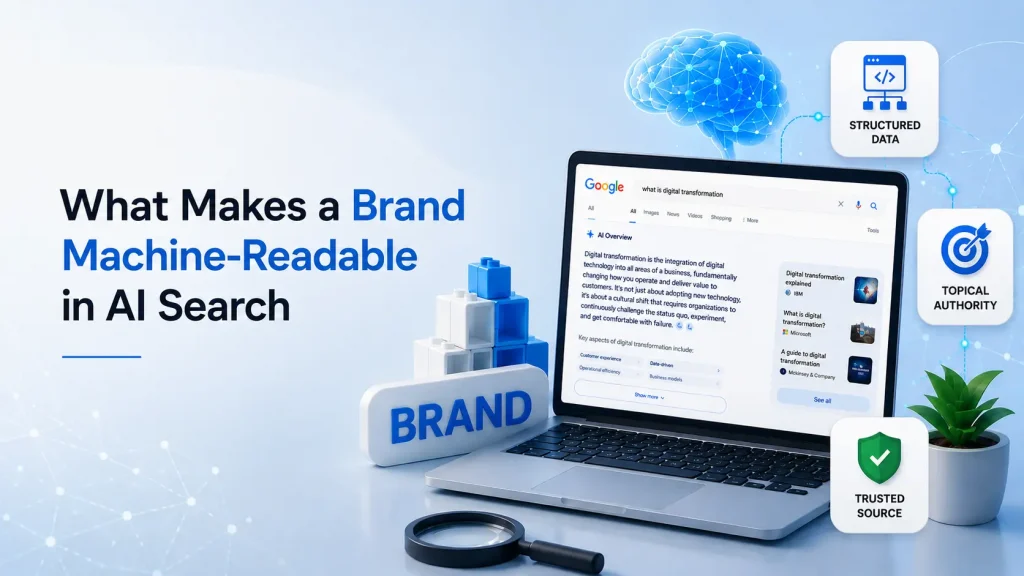
Search is changing. Users are no longer only clicking blue links — they’re asking ChatGPT, Gemini, Perplexity, and Google AI Overviews to find what they need. These systems don’t just return results; they summarize, evaluate, and directly recommend brands. The question is: will yours be one of them?
The brands that win in this new environment are the ones AI can actually understand. That means being machine-readable — not just human-friendly. So, what actually makes a brand machine-readable in AI search?
What Does "Machine-Readable" Mean?
A machine-readable brand is one that AI systems can understand, categorize, trust, retrieve, and reference with confidence. This goes well beyond traditional SEO. It’s about structuring your online presence so that AI — not just search crawlers — can interpret who you are, what you do, and why you’re credible.
In simple terms, machine-readable brands make it easier for AI systems to understand who they are, what they offer, and why they should be recommended.
How AI Search Engines Understand Websites?
Modern AI search systems rely heavily on Natural Language Processing (NLP), semantic understanding, and entity recognition. Instead of looking only at keywords, AI systems evaluate:
- Context and meaning
- Website structure
- Topical authority
- Consistency across platforms
- Technical accessibility
- User-focused content
This means businesses must optimize for clarity, structure, and authority rather than outdated SEO tactics.
AI doesn’t rank pages anymore — it evaluates brands. The difference is enormous for how you should think about your online presence.
The Six Elements of a Machine-Readable Brand
Consistent name, services, descriptions, and NAP data across every platform and page.
Clean heading hierarchy, FAQ sections, topic clusters, and logical page structure.
Organization, FAQ, Product, and Article schema help AI parse structured meaning from your pages.
Consistent expert-level content around specific topics signals depth and domain trust to AI.
Citations, mentions, and trusted references across the web build your brand as a recognized entity.
Fast loading, mobile-friendly, crawlable structure, and strong internal linking for indexability.
Let's take a closer look
Brand identity consistency is the foundation. If your company name, service descriptions, or contact details differ between your website, Google Business Profile, LinkedIn, and social pages, AI systems get conflicting signals and deprioritize your brand as unreliable. Consistency is trust.
Structured content means organizing pages so that AI can parse hierarchy and meaning — not just humans. Clear H1/H2/H3 heading structures, topic clusters that group related content, and FAQ blocks that answer real questions in plain language. Effective UI/UX design improves AI readability by organizing information in a way that is intuitive for both users and machines.
Structured content organizes web pages for both AI and humans. Use clear headings, create topic clusters, and include simple FAQs. Effective UI/UX design ensures information is intuitive, improving AI readability.
Schema markup is the explicit layer of structured data that tells AI exactly what a page is about. Organization schema, FAQ schema, Product schema — these are machine-readable signals embedded in your code that AI search engines actively rely on when choosing sources to surface.
Topical authority is built over time. AI trusts brands that consistently publish expert-level content within a defined domain. Scattered, generic content across many unrelated topics signals shallow expertise. Deep, consistent coverage of your core subjects — whether that’s software development, digital transformation, or warehouse management — signals authority.
Entity-based SEO reflects how Google now understands brands as entities, not just websites. Your brand’s presence across the web — mentions, citations, backlinks from trusted sources — contributes to your entity authority. The more consistently your brand appears across credible references, the more confidently AI can place you in its knowledge graph.
Technical SEO remains the foundation of AI visibility. Page speed, mobile responsiveness, and a clean crawlable structure, where professional web development directly impacts your search presence, with strong internal linking ensuring AI systems can actually access and index your content in the first place.
Why Traditional SEO Alone Is No Longer Enough?
Traditional SEO focused heavily on keyword rankings and search visibility. However, AI-driven search prioritizes contextual relevance, trust, expertise, and structured information.
The shift isn’t just tactical — it’s philosophical. Traditional SEO optimized pages for crawlers by checking keyword density. AI search optimizes for a system that actually understands meaning. That requires a fundamentally different approach to how you present your brand online.
How Google AI Overviews and ChatGPT Choose Sources
AI Overviews and ChatGPT Search don’t randomly select sources. They prioritize brands that demonstrate EEAT — Experience, Expertise, Authoritativeness, and Trustworthiness. Practically, this means trusted sources with structured, authoritative answers and concise explanations are consistently chosen over thin or unstructured content.
AI systems typically prioritize sources that demonstrate:
- Clear expertise
- Structured answers
- Strong topical authority
- Accurate information
- Technical accessibility
- Consistent branding
If your content is unclear in structure, inconsistent in identity, or weak in topical depth, AI systems will simply pass over your brand — even if you rank well in traditional search.
Common Mistakes That Reduce AI Visibility
Generic AI-generated content deserves special attention here. Ironically, flooding your site with undifferentiated AI-written text actively harms your AI search visibility. These systems are increasingly capable of detecting shallow, generic content — and deprioritizing it. Depth, specificity, and genuine expertise are what stand out.
How to Prepare Your Brand for AI Search?
The path to AI visibility is a structured investment across several areas. Start by auditing your brand identity for consistency across all platforms. Then work systematically through your content structure, implement schema markup where it’s missing, and build topical depth in your core subject areas. Technical SEO improvements — speed, mobile experience, internal linking — should run in parallel.
Brands Already Optimizing for AI Readability
- Shopify uses structured product data and semantic architecture to improve discoverability.
- HubSpot builds strong topical authority through interconnected content clusters.
- Zapier structures documentation and FAQs for machine-readable retrieval.
The Future of Search Is AI-Assisted
Conversational search, AI agents, and machine-readable ecosystems are not future possibilities — they are the present reality. Users increasingly get answers without clicking, which means AI becomes the decision-maker about which brands to surface. The brands winning this new paradigm are those that have built deep entity authority, structured their content for semantic understanding, and maintained consistent, expert-level presence across the web.
Brands that are easiest for AI to understand will become easiest for users to discover. The investment you make now in machine-readability compounds over time as AI search continues to grow — and if you’re looking to accelerate that journey, partnering with an experienced digital transformation company like Fegno is the fastest way to close the gap.

Sreekumar is an SEO Analyst at Fegno Technologies, with over 10 years of expertise in optimizing websites for search engines, enhancing their online visibility, and developing data-driven SEO strategies. Passionate about delivering measurable results and staying ahead of industry trends.

 Schedule An Appointment