
Your pages rank well on Google, yet customers now get answers from AI Overviews, ChatGPT, and Perplexity before they ever click. That gap costs real traffic. Hybrid engine optimization in SEO closes it by preparing one piece of content for both traditional search engines and AI answer engines.
At Fegno Technologies, we help businesses build visibility that holds up across both. This guide walks you through a practical process, from technical foundations to measurement, so you can improve your results without guessing.
Hybrid AI SEO Strategy: The Core Steps
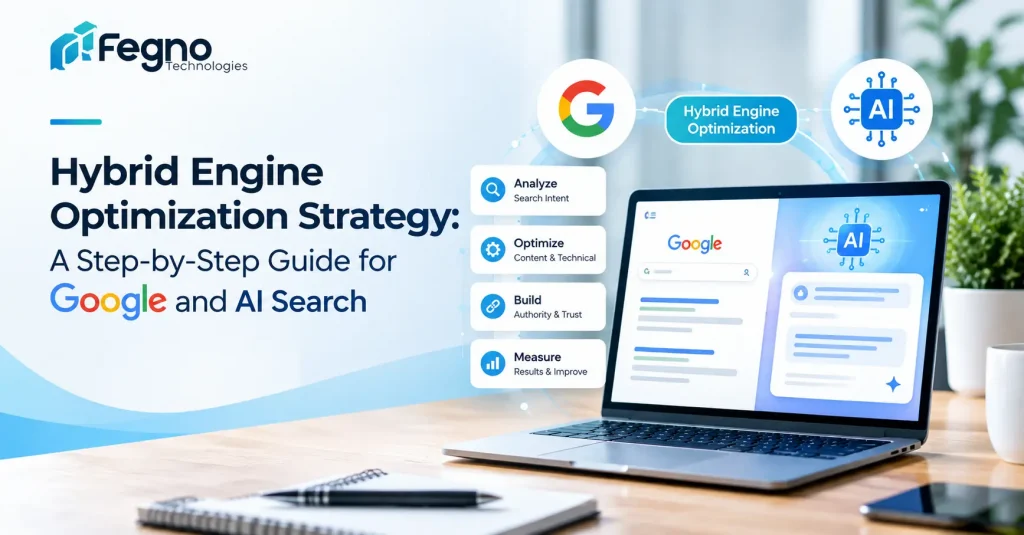
A hybrid strategy optimizes content for both search rankings and AI citations. Start with a technical audit, map topics to user intent, write direct answers, add structured data, strengthen brand entities, and track rankings alongside AI mentions. Each step supports the others, so one page can earn clicks and citations.
Here is how the process works in practice:
- Audit your technical base. Fix crawl errors, slow pages, and broken internal links first.
- Map intent to topics. Group keywords by what people actually want to know or buy.
- Answer questions early. Place a clear 40–60 word answer directly under each relevant heading.
- Add schema markup. Structured data helps both Google and AI systems understand your page.
- Build trust signals. Show author expertise, cite sources, and keep facts current.
For a deeper look at combining these tactics, see this overview of a Hybrid AI SEO Strategy.
Before you commit, weigh the hybrid engine optimization advantages and disadvantages. On the plus side, you gain wider reach and less dependence on a single traffic source. On the downside, the approach needs more upfront planning, and AI visibility is still harder to measure than rankings.
Choosing an SEO Company in Kochi for Hybrid Search Success
Local context matters. A Kochi business competes for “near me” searches on Google while also trying to appear when people ask AI tools for recommendations. A local partner understands both the market and the language customers use.
Look for a team that can show real case work, explains its methods clearly, and reports on more than rankings. Ask how they handle Google Business Profile, local citations, and AI visibility together. Transparent reporting is a good sign of a trustworthy partner.
Why Do Google and AI Search Reward Different Signals?
Google leans on links, relevance, and page experience. AI engines favor content that is clear, quotable, well-sourced, and consistent across the web.
This is where entities come in. AI systems build understanding around brands, people, and topics, not just keywords. Entity knowledge graph optimization helps them connect your business with the right subjects. In our experience, brands with consistent names, descriptions, and profiles across the web are easier for these systems to interpret.
What Are the Common Mistakes to Avoid?
Many teams treat AI search as a separate project. That splits effort and creates conflicting content.
- Chasing AI mentions and ignoring fundamentals. Weak technical SEO limits both channels.
- Writing long intros before the answer. Lead with the answer, then add detail.
- Skipping structured data. Without it, machines must guess what your page means.
- Measuring only rankings. Track branded searches, citations, and conversions too.
The fix is simple: build one strong page per topic and optimize it for both audiences.
When Should You Bring in Professional Help?
Consider expert support if your rankings are stable but traffic is falling, or if competitors appear in AI answers and you do not. The same applies when your team lacks time for technical audits, schema work, or ongoing tracking.
Professional help also pays off during a website redesign or migration, when mistakes can erase years of progress.
Expert Tips and Best Practices
- Update key pages regularly. Fresh, accurate facts build trust with readers and machines.
- Use question-based subheadings. They mirror how people search and speak to AI tools.
- Show real authorship. Add bylines, credentials, and sources to support E-E-A-T.
- Keep brand details consistent. Match your name, address, and descriptions everywhere.
- Test and refine. Check which pages earn citations, then replicate their structure.
Conclusion
Search is no longer one channel. Hybrid engine optimization lets you earn rankings on Google and citations in AI answers from the same strong content. Start with technical health, answer questions directly, strengthen your entities, and measure beyond clicks.
If you want expert guidance, Fegno Technologies can audit your current visibility and build a roadmap that fits your goals. Talk to us, your trusted SEO company in Kochi, to get started.
Frequently Asked Questions
It keeps your brand visible on Google and in AI answers, so you do not lose reach as search habits change.
Start with a technical audit to fix crawl, speed, and indexing issues that limit every channel.
Most sites see early movement within a few months, though timelines vary by competition and site health.
Write clear, sourced answers, add structured data, and keep your brand details consistent across the web.
Yes, because strong rankings, crawlability, and authority also help AI systems find and trust your content.

Senior Front-End Developer at Fegno Technologies with 5+ years of experience crafting clean, responsive, and scalable web applications. Specialized in React.js, Next.js, JavaScript, HTML5, and CSS3, turning complex ideas into seamless digital experiences. Passionate about UI/UX excellence, performance optimization, and modern web technologies.

 Schedule An Appointment