
Over the past decade, warehouse operations have undergone a significant transformation. Businesses currently handle significantly more orders than ever before due to the explosive growth of eCommerce. Consumers anticipate correct order fulfilment, quicker delivery, and real-time product updates.
Warehouses also have to deal with a number of operational difficulties, including:
- Increasing the volume of orders.
- Demand for faster fulfillment
- The necessity of keeping precise inventories
- Lack of workers in logistics
- Rising pressure to reduce operational costs
The primary functions of traditional warehouse systems were inventory tracking and basic operations management. However, these systems frequently find it difficult to meet contemporary expectations as supply chains get increasingly intricate.
Artificial intelligence is here, making a big impact. By combining artificial intelligence (AI) with warehouse management systems (WMS), companies are transforming conventional warehouses into more intelligent, more efficient operational hubs.
What is AI in Warehouse Management Systems?
“Artificial intelligence (AI) in warehouse management systems” refers to the application of advanced technologies that enable data analysis, trend prediction, and automated decision-making processes in warehouses.
These technologies consist of:
- Machine learning
- Predictive analytics
- Data pattern recognition
- Automation algorithms
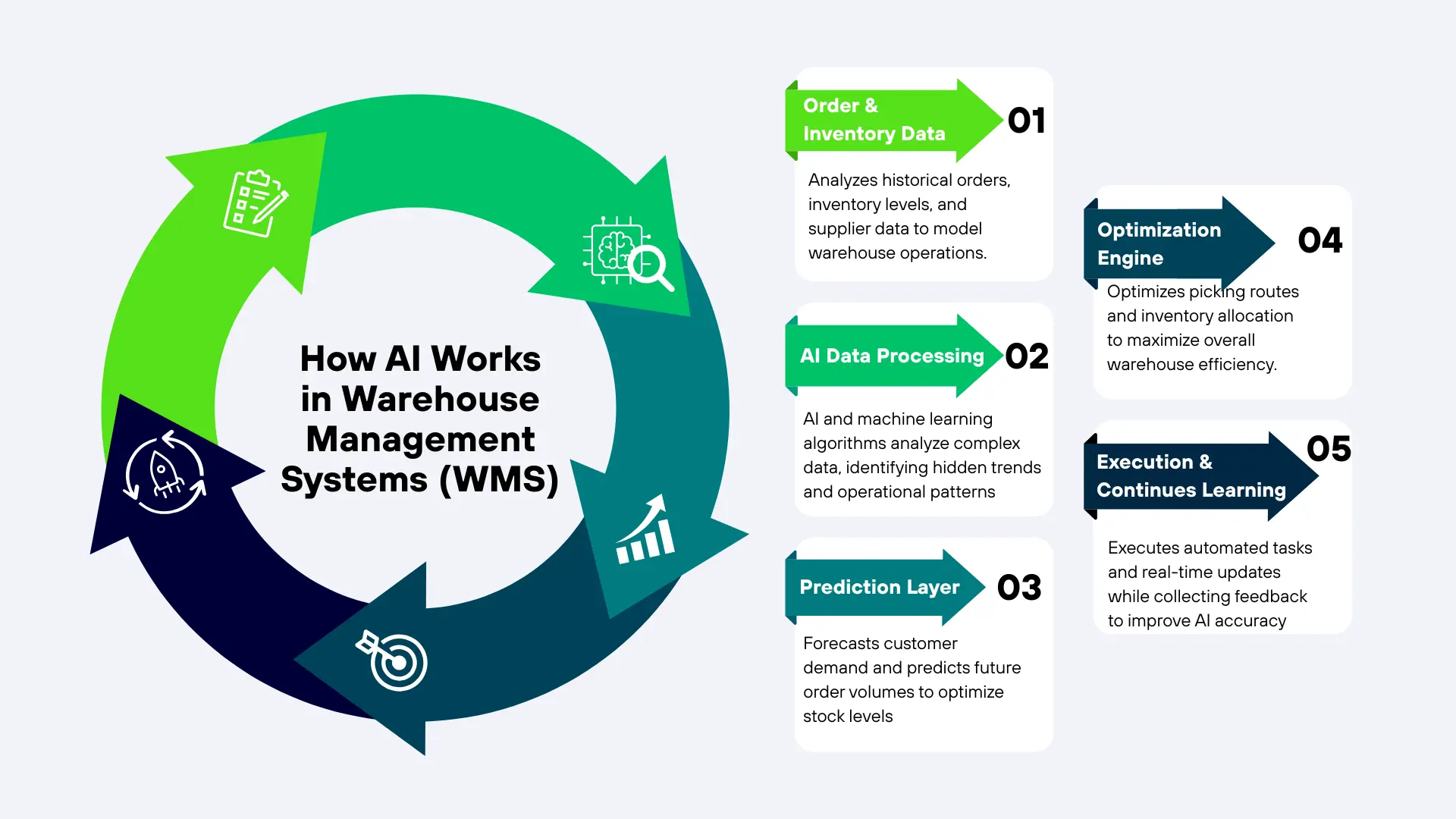
AI-powered WMS systems examine vast volumes of operational data to find trends and boost warehouse productivity rather than just tracking inventory.
To put it simply, artificial intelligence (AI) turns a warehouse management system from a simple tracking tool into a sophisticated decision-making system.
AI Capabilities in Modern Warehouse Management Systems
AI-Powered Demand Forecasting
One of the most crucial aspects of warehouse management is demand forecasting. AI assists companies in forecasting future demand by examining the following:
- Historical sales data
- Seasonal demand patterns
- Customer purchasing trends
Warehouses can prepare inventory more precisely with the help of this information. Better stock planning, fewer stock shortages, and fewer overstock scenarios – all of which raise storage costs – are the outcomes.
Intelligent Inventory Optimization
For a warehouse to operate efficiently, the proper level of inventory must be maintained. While too little inventory might lead to missed sales, too much inventory raises storage expenses.
AI systems constantly examine variables like the following:
- Order frequency
- Supplier lead times
- Warehouse capacity
AI uses this data to help maintain ideal stock levels.
Better inventory turnover, cheaper storage, and more efficient supply chain operations result from this.
Smart Picking Optimization
One of the most time-consuming tasks in a warehouse is order picking. By developing optimised picking strategies, AI aids in this process’ improvement.
AI-powered WMS platforms, for instance, can:
- Generate efficient picking routes for warehouse staff
- Group multiple orders for faster picking
- Prioritize urgent shipments
Businesses can increase overall efficiency and expedite order fulfilment by minimising needless travel within the warehouse.
Automated Stock Allocation
AI also makes it easier to assign stock to incoming requests. AI-powered systems assign available inventory automatically rather than by hand depending on variables like:
- Warehouse location
- Shipping priorities
- Current stock availability
As a result, warehouses process orders more quickly and with less manual intervention.
Real-Time Warehouse Analytics
Real-time operational insights and comprehensive analytics are offered by contemporary AI-driven WMS platforms. Supervisors can keep an eye on crucial performance metrics like:
- Order processing speed
- Inventory movement
- Warehouse productivity
- Operational bottlenecks
Businesses can utilise these insights to pinpoint areas for development and consistently enhance warehouse performance.
How AI Integrates with Warehouse Management Systems?
AI is not a stand-alone system. Within the warehouse environment, it integrates with a variety of technologies.
An example of an AI-powered warehouse setting would be:
- Warehouse Management System (WMS)
- AI analytics engines
- IoT sensors and tracking devices
- ERP systems
- Mobile warehouse applications
AI models gather and analyse operational data from these systems. The technology can provide recommendations or even automate some warehouse decisions based on this analysis.
The warehouse environment is made smarter and more responsive by this integrated approach.
Business Benefits of AI-Powered WMS
According to Logiwa and Shipedge, order picking is the most labor-intensive activity in warehouse operations, typically accounting for 50–55% of total operational costs, with some estimates reaching 60–65%. AI-powered warehouse management systems reduce these costs by optimizing picking routes, automating stock allocation, and improving operational decision-making. Despite the initial investment, many businesses achieve ROI within 18–36 months, while AI adoption can reduce overall logistics costs by 15% or more.
Improved Inventory Accuracy
AI improves visibility into stock levels throughout the warehouse and helps minimise inconsistencies in inventory records.
Faster Order Fulfillment
Order processing and shipping times are shortened by automated decision-making and optimised operations.
Lower Operational Costs
Automation reduces inefficiencies in warehouse operations and lessens the need for manual work.
Better Demand Planning
AI-based forecasting helps businesses align inventory levels with expected demand.
Enhanced Supply Chain Visibility
Real-time insights allow businesses to quickly identify disruptions and respond more effectively.
Real-World Examples of AI in Warehouse Management
Several global companies like Amazon, Walmart, and DHL use AI to improve warehouse efficiency, inventory accuracy, and fulfillment speed.
Amazon
- Uses AI, robotics, and machine learning across its fulfillment centers.
- Over 750,000 mobile robots move shelves to workers, reducing travel time.
- AI forecasting analyzes demand for hundreds of millions of products daily.
- The Sequoia system enables inventory storage and movement up to 75% faster.
Walmart
- Uses AI to improve inventory management and supply chain planning.
- The Eden AI system analyzes product images to detect produce freshness and reduce food waste.
- Plans to automate around 65% of fulfillment centers using AI-powered robotics.
- AI systems adjust inventory and replenishment in real time during demand spikes.
DHL
- Uses AI-driven vision picking with smart glasses to guide warehouse workers.
- Productivity increased by 25% or more in pilot programs.
- AI route optimization reduces employee travel distance by up to 50%.
- Uses digital twins to simulate warehouse operations before implementing changes.
Other Industry Examples
- Ocado: AI robots pick and pack grocery orders with high precision.
- JD Logistics: AI determines optimal product placement in automated warehouses.
- GXO Logistics: AI drones scan up to 10,000 pallets per hour for inventory tracking.
Challenges of Implementing AI in Warehouse Systems
Even though AI has many benefits, there may be certain difficulties in putting AI-driven warehouse solutions into practice. Some common barriers include:
- Poor or inconsistent data quality
- Difficulty integrating with legacy systems
- Infrastructure investment requirements
- Workforce adaptation to new technologies
A solid digital foundation and well-integrated software systems are necessary for the successful implementation of AI.
For AI models to function well, businesses must also make sure that their warehouse data is correct and organised correctly.
The Role of Custom Software in AI-Driven Warehouses
To fully utilise AI in warehouse operations, many businesses need customised IT solutions.
Implementing AI-powered warehouse systems often involves:
- Custom WMS platforms
- Enterprise software integration
- Scalable cloud infrastructure
- Mobile warehouse applications
Businesses can create specialised logistics software solutions that meet their operational needs by partnering with an experienced software development company like Fegno Technologies, which builds scalable enterprise platforms, including warehouse management systems and logistics automation tools. With the right software architecture and integration strategy, businesses can successfully incorporate AI into warehouse operations and improve productivity.
Enabling Smart Warehouses with Modern WMS Platforms
Modern digital logistics depends heavily on advanced warehouse management systems. A variety of features that facilitate more intelligent warehouse operations are supported by these platforms.
Key capabilities include:
- Real-time inventory management
- Support for warehouse automation technologies
- Advanced analytics and reporting tools
- Mobile warehouse applications
- Integration with AI-driven technologies
Businesses may manage warehouse operations more effectively and get ready for future technology improvements with the help of solutions like the Fegno Warehouse Management System Software.
The Future of AI in Warehouse Management
AI is still developing quickly, and in the upcoming years, it will play a bigger part in warehouse management.
Among the new trends are the following:
- Autonomous warehouse robots
- AI-powered demand prediction models
- Digital twin warehouses for simulation and planning
- Predictive supply chain optimization
- Augmented reality tools for warehouse operations
Warehouses will become more automated, linked, and intelligent as these technologies advance.
It is anticipated that AI will play a major role in the next generation of smart warehouse environments.
Conclusion
Artificial intelligence is transforming warehouse management by redefining conventional operating systems into intelligent, data-driven platforms.
Businesses may increase productivity, save operating costs, and more precisely control inventory with the use of AI-powered WMS solutions. Additionally, they facilitate quicker order fulfilment and offer insightful information that helps improve logistics choices.
Businesses that implement AI-driven warehouse solutions now will be better equipped to handle the expanding needs of contemporary supply chains.
To learn how intelligent warehouse technology can support your operations, explore the capabilities of the Fegno Warehouse Management System.

Head of Development at Fegno Technologies, with 12+ years of experience in product engineering. A specialist in technical architecture and UI/UX, he leads teams to build scalable, high-performance digital solutions.

 Schedule An Appointment